
The Rolex Submariner, first unveiled in 1954, was a groundbreaking diver’s watch – the first wristwatch waterproof to 100 meters. In its earliest form (refs. 6204/6205), it even lacked the now-familiar “Mercedes” hands, using simple pencil hands and basic luminous markers. By the late 1950s and early 1960s, Rolex refined the Submariner into the classic design we know today – adding oversized crowns, crown guards and switching from radium to safer tritium lume. These mid-century Submariners were built as uncompromising professional tool watches, and naturally found their way into elite marine service. Rolex worked closely with navies and deep-diving companies throughout the Cold War era, embedding Submariners into the history of elite frogmen and explorers. As a result, certain early Submariners carry extraordinary provenance – for instance, prototypes or military-issue models signed out by governments – that make them especially coveted by collectors and wealthy connoisseurs today.
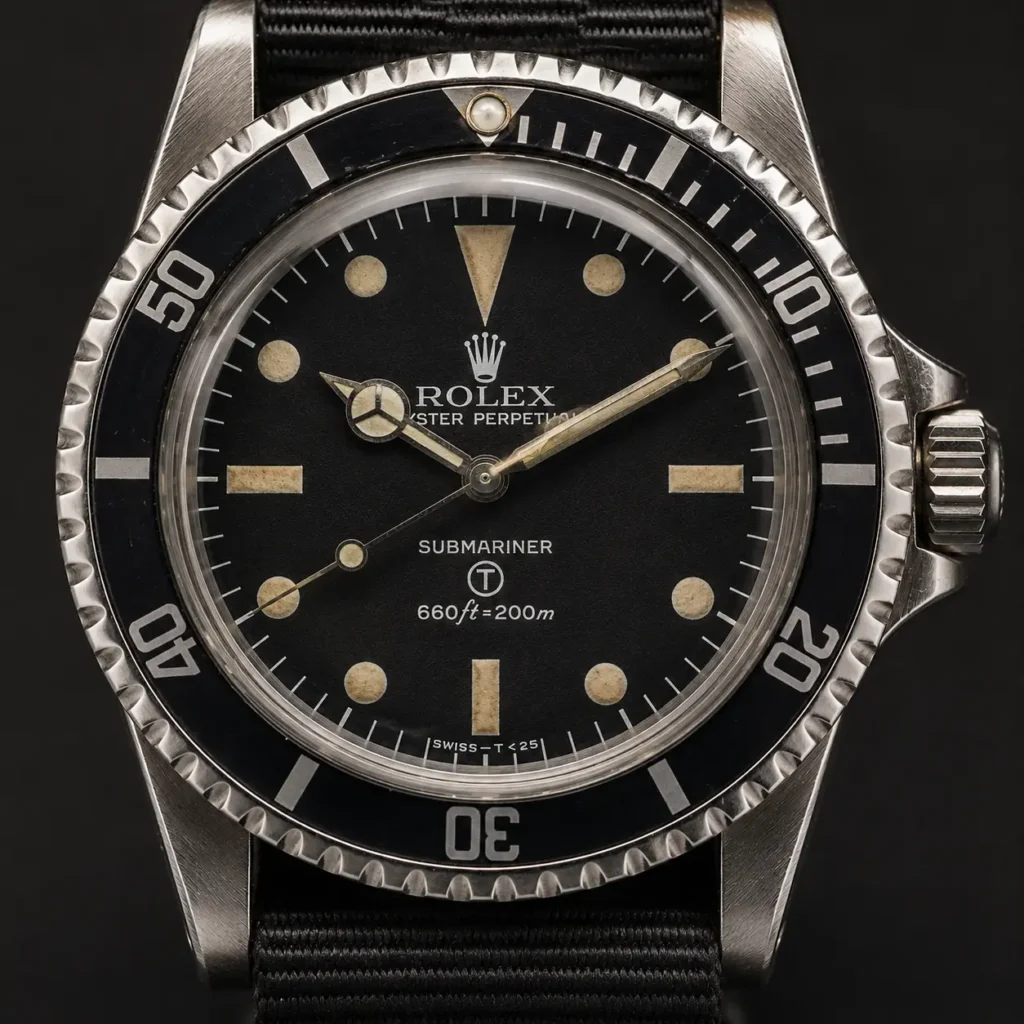
The intersection of horological innovation and global history is evident in these watches. For example, Rolex founder Hans Wilsdorf honored World War II RAF pilots by creating the Air-King line after the war, and soon thereafter Rolex dedicated the Submariner to underwater adventurers. The Submariner became famous for its role in British naval diving. Between 1972 and 1976, Rolex produced a series of military-issue Submariners (Ref. 5517) “commissioned by the British Ministry of Defense”. These Mil-Subs featured several exclusive features: fixed lug bars for NATO straps, a fully calibrated 60-minute timing bezel, broad “sword” hands, and a large encircled “T” over the depth rating to denote tritium lume. They were also engraved on the caseback with military issue codes (such as “0552” for Royal Navy divers) and the famous Broad Arrow symbol, all indicating genuine Ministry-of-Defense provenance. Only a few thousand of these full-spec MilSub watches were made, many of which were retired into private hands or lost, so surviving original pieces are exceedingly rare. (As Sotheby’s notes of one such watch: “less than a third remain” of the 1,500 estimated Rolex MilSubs produced.)
Collectors prize watches like this not only for their rarity, but also for their documented backstories. One famous example is the so-called “Shadow” Submariner: a 1975 Ref.5513 MilSub destined for the South African Special Forces, factory-coated entirely in matte black to avoid glare. Rolex archives (verified by fax to dealers) confirm that this blackout watch was built in 1975 “destined to the South African army” and finished in gunmetal black. Its provenance is tightly woven into Cold War history – special forces sent into Angola during Operation Savannah to combat communist-backed troops, where even body paint and watch cases were rendered black for concealment. Such a unique military saga now adds to the watch’s mystique and value.
Beyond national militaries, Rolex also partnered with elite diving firms. In the late 1960s and 1970s, the French diving company COMEX (Compagnie Maritime d’Expertises) required watches for record-breaking deep-sea missions. Rolex answered with Submariner prototypes fitted with helium escape valves. The famous Ref.5514 (based on the 5513) was produced exclusively for COMEX, instantly recognizable by “COMEX” printed on the dial. These extraordinarily scarce watches (only a few hundred made) were commissioned by pioneering divers and industrial teams, linking them to the history of offshore oil exploration. Such pieces, when they surface, carry not only a hefty price but also industrial-archaeology provenance.
Historical provenance also comes through high-profile owners. A legendary early Submariner – the “Big Crown” Ref.6538 – achieved icon status partly through James Bond films (Connery wore one in Dr. No). One particularly immaculate 1959 “Big Crown” Submariner just sold for $432,000 at Sotheby’s in 2025, coming directly from the family of the original owner. In another case, Christie’s recently auctioned an extremely rare prototype 18k white-gold Submariner (Ref.1680) with a known Rolex-family provenance – it was worn by the nephew of the original owner, both of whom worked at Rolex, and consigned by their descendants. Even cultural icons added to the legend: Steve McQueen’s personal Submariner (a Ref.5512) is slated to hit the auction block, further weaving the watch into pop-culture history. All these examples underscore that detailed provenance – from military issue records to family archives – can exponentially increase the value and cachet of a vintage Submariner.
Military Commissions and Elite Maritime History
The Submariner’s appeal to maritime elites is well documented. In addition to the British MOD and COMEX examples, other navies and commando units placed special orders. For instance, Rolex delivered “MilSub” Submariners to the British Army (0552 code) and Royal Navy (W10 code) divers in the 1960s–70s. These modifications were so significant that collectors use them as historical fingerprints. A Rolex Submariner with a fully graduated bezel (minutes all around), fixed lug bars, and stubby sword hands (as in the figure above) immediately signals an original MOD-issued dive watch. (Normal 5513s of the era had Mercedes hands and 15-minute bezels.) The Bob’s Watches review of a 1976 5513/0 explains, “These Rolex MilSub watches were used by both clearance divers… and deep, mine-hunting divers” and were “never released to the public,” making them very rare.
Rolex military Submariners were treated as official equipment. Casebacks often bear engraved issue numbers and broad arrows, tying them to specific naval units. In the 1970s, British frogmen even referred to Rolex in their “Diver’s Bible,” reminding divers to inspect the watch for safety before and after use. After service, most MilSubs were returned to MOD and many were scrapped or demagnetized; surviving examples often came via service auction or private estates, contributing to their tightly documented histories.
Significant private collections and auctions reveal more provenance. Sotheby’s notes one MilSub 5517 sold by descendants of the original Navy diver who received it. Another example is the “double reference” watch – a ref.5513 with ref.5517 stamped under the lug – which was documented as being issued in 1974 with full military engravings. Vintage registries and auction catalogs often list the issuance year and recipient (sometimes named), confirming authenticity. Collectors covet MilSubs with such pedigrees because each engraved number and hand-written letter is proof of service history.
Beyond military forces, early Submariners also found owners among elite explorers and leaders. The prototype white-gold Ref.1680 mentioned above was an experimental showpiece never sold commercially, its provenance recorded by Rolex experts. And while not “commissioned” by a government, the fact that it stayed in a Rolex employee’s family for decades adds to its story. In practice, any connection to a historic figure (naval officer, explorer, celebrity) or expedition adds a layer of interest for affluent collectors. Thus, provenance research often involves scouring old shipping logs, naval dispatches, or even museum exhibits for photographic evidence of a watch in use.
In summary, the Submariner’s deep-sea legacy – from British and South African special forces to French oil-rig divers and Hollywood spies – gives each rare example a story. Articles like this one underscore how UHNW collectors link their passion to history: owning one of these watches is like holding a piece of naval heritage in the hand. Auctions prove it too: each high-end sale typically mentions the watch’s history (unit issued, owner name, even wartime action), making provenance a headline-grabber. As Sotheby’s put it, “each Rolex watch carries a unique history and provenance” – and for vintage Submariners, that history often reads like a naval epic.
Forgery Detection via Vintage Lume Patina
With high value comes counterfeits. Enthusiastic UHNW collectors must be vigilant: a vintage Submariner with false credentials not only tarnishes the story, it destroys value. Fortunately, authenticators have learned to spot forgeries by examining the dial and luminous aging. Genuine mid-20th-century Rolex dials were printed and assembled with meticulous standards that are hard for fakers to replicate. Any lettering on the dial – the Rolex name, depth rating or hour markers – should appear crisp and slightly raised, with no bleeding of ink. The five-pointed Rolex crown logo, in particular, should gleam from hand polishing. In contrast, counterfeit dials often show imperfect text or dull factory paint: even the “R” in ROLEX may be slightly off in shape.
The luminous material on the hour markers and hands is another key indicator. Vintage Submariners used tritium-based lume (marked “T Swiss – T <25” on dials after 1964). Over decades, this tritium paint oxidizes to warm cream or light brown tones. Collectors value this patina as a sign of originality. Watchfinder emphasizes: “Vintage models…the tritium-based paint…would have developed a slight brown or cream patina” and crucially notes the lume on dial and hands must match in age and color. In other words, if the lume on the hands is bright white but the markers have yellowed, that’s a red flag. Rolex passion experts likewise point out that fakers often apply lume unevenly: under magnification, fake tritium may appear too “closed” or uniformly colored, whereas real old tritium develops subtle cracks and graininess. One guide bluntly states: “Look from the side into the dial, you will notice that the patina is not natural” on a counterfeit.
Geiger counters and UV lights are also standard tools. As one expert advice notes, having a Geiger counter “is a must to determine the radiation of tritium and radium”. A genuine 1960s Submariner, when briefly charged by light, will glow dim green for a short time – anything more vibrant might mean the lume has been tampered with. Conversely, if the lume doesn’t glow at all under UV, the watch might actually predate tritium use (pre-1963 Rolex would glow from radium) or the tritium has completely decayed, which is normal. Consistency is key: true vintage Submariners show uniform aging (for instance, a “creamy” silver–yellow on all indices).
In practice, authenticators follow a step-by-step “flowchart” of checks. For example:
Serial and Reference Check
Verify the case back engravings and stamped reference number against Rolex archives and known production ranges (odd font or spacing can indicate recasing).
Dial and Crown Examination
Inspect the Rolex coronet and printing under a loupe – any smudges or misaligned markers are suspicious. The crown logo should be finely detailed, not crude.
Luminous Patina Inspection
As above, confirm the lume has aged evenly. Any patchy or globby lume suggests reluming or forgery. Use a Geiger counter to confirm the presence (or expected absence) of tritium.
Handset and Dial Font
Make sure the shape of the hands (e.g. sword vs. Mercedes) matches the expected reference. (Some authentic MilSubs delivered originally with Mercedes hands later had swords, so expert knowledge is needed.)
Case Engravings and Bracelets
Original military Submariners will have solid fixed bars (not spring bars), and casebacks engraved with MOD codes or serials consistent with issue batch. Check that any supplied strap or bracelet is period-appropriate.
Provenance Papers
Review any accompanying documents – original boxes, certificates, and service records. Provenance from the original buyer (military records, export forms) seals authenticity. “If a deal seems too good,” warns one guide, “walk away!”.
These checks, often distilled into infographic-style guides, help distinguish white-hot treasure from convincing fakes. For the UHNW collector, building this knowledge (or consulting an expert) is essential before committing six-figure sums. In the end, a genuine Submariner with documented history and matching patina is more than a timepiece – it’s an historic artifact whose wear patterns tell the story of decades in the deep. As one collector adage goes: “Every scratch and fading bezel tells part of the watch’s story.” And for these ultra-rare Submariners, the story of military valor or scientific daring is exactly what gives them their enduring value.