
In the world of ultra-wealthy collectors, a classic car’s value is shaped more by its pedigree than its speed. Provenance – the documented history of a vehicle – is essential. It binds together ownership records, race logs, and original factory data into a “living” archive that underpins authenticity. For UHNW connoisseurs, a vintage Ferrari or Bentley is not just a car but a rolling artifact. Its worth hinges on verifiable links to famous races, esteemed owners, and factory build sheets. As one expert notes, “a well-documented provenance can verify authenticity and enhance desirability”. In practice this means assembling meticulous binders of registration cards, invoices, period photos and chassis records. At the highest levels – concours d’élégance or major auctions – judges and brokers expect to see every major component traced back to its origin. In fact, professional preparation guides advise bringing “build sheets, period photographs, and VIN-specific documentation,” noting that “factory authenticity certificates carry significant weight” at top-tier events. This culture of proof – born of passion and diligence – underlies the premium classic car market.
Documenting the Mille Miglia and Le Mans Pedigree
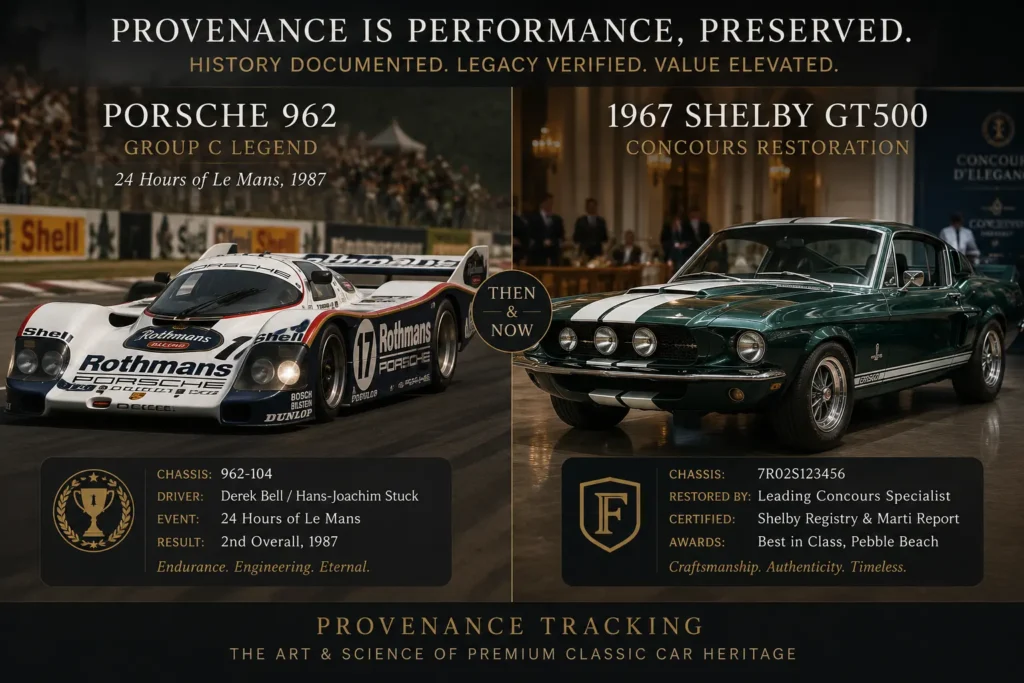
The most celebrated provenance comes from competition history. Cars with Mille Miglia or 24 Hours of Le Mans credentials command attention. Specialists leverage official race archives and registries to verify participation. For example, the Registro 1000 Miglia in Italy catalogs every car that entered the original Mille Miglia (1927–1957). By registering, a collector obtains a certified record of that car’s edition, guaranteeing its eligibility for historic re-enactments and establishing its speed-age prestige. Similarly, the Automobile Club de l’Ouest (ACO), organizer of Le Mans, maintains detailed entry lists, results and driver logs from every 24-hour race. Verifying a Le Mans pedigree often involves cross-checking engine and chassis numbers against period timing sheets or official entry forms. In short, documents from these events become a high-grade provenance pedigree.
Mille Miglia registry
Cars proven to have started the Mille Miglia earn recognition and authenticity. The Registro 1000 Miglia archives “catalog, classify and certify the main cars” of the original races, and issues certificates guaranteeing genuine competition history.
Le Mans archives
Likewise, the ACO and associated historians maintain race entry cards, timing sheets and classified results. A surviving Scarab or Jaguar with matching ACO records is far more coveted. Notably, auction houses highlight such history: cars like Ferraris with extensive period racing—Mille Miglia, Targa Florio, Le Mans—see their provenance “transform…into a documented piece of motorsport history”. The RM Sotheby’s Ferrari articles emphasize that cars raced by famous drivers or works teams (with matching serial numbers) fetch top prices.
Authenticity is further bolstered by period artifacts: rally plates, original pit decals, and even surviving trophies or drivers’ logbooks. Each item is cross-referenced. For example, a 1956 Ferrari 290 MM’s competition sheet might list its record (Nassau win, Buenos Aires, Mille Miglia podium). In one case, an RM Sotheby’s sale noted the 290 MM’s matching-numbers engine and body and Classiche documentation. These factors – documented wins and original parts – were cited as “critical when evaluating historically important Ferraris”.
The Role of Factory Certifications (Ferrari Classiche)
No provenance strategy is complete without factory records and certifications. Major marques now offer programs to authenticate heritage models. Ferrari Classiche, for instance, was launched in 2005 to verify that a vintage Ferrari’s chassis, engine, gearbox, bodywork and interior match the Maranello archives. Technicians pull the original assembly sheets (the so-called Red Book) dating back to 1947, and check every major component. Passing the inspection earns a car an official Certificate of Authenticity (signed by Piero Ferrari), known in the trade as the “Red Book”. This factory-backed pedigree report not only confirms originality but also grants access to genuine spare parts and VIP events. For UHNW buyers, Classiche is the gold standard: “Ferrari Classiche certification verifies originality against factory records” and “answers the fundamental question: is this Ferrari exactly what it claims to be?”.
Other heritage programs perform similar roles. Lamborghini’s Polo Storico team maintains a vast archive of technical drawings, production sheets and correspondence. This “living memory of the Bull” – now digitized – supports restoration and authentication. Notably, Polo Storico has reassembled cars (the Countach LP500 prototype, a Miura from The Italian Job film) using archive documents to reconstruct every detail. In Britain, the Rolls-Royce Foundation offers research services on original build sheets, chassis cards and factory records. Likewise, the British Motor Industry Heritage Trust can issue a Heritage Certificate – a certified copy of a car’s ledger entry – confirming its exact spec and despatch date as it left the factory.
Factory build records
If chassis/engine numbers match the factory ledgers, that proof is bulletproof. Dedicated archives (Maranello, Sant’Agata, Crewe, Goodwood) hold original build sheets and dealer records for vintage cars. Having an unbroken “chain of authenticity” traced to these documents is invaluable.
Concours-level documentation
Top-level concours prep explicitly recommends bringing factory papers and restoration records. Judges “expect…build sheets, period photographs, and VIN-specific documentation,” and penalties apply for missing proof. In other words, a wallet of provenance is as important as waxed paint or flawless panel gaps.
In practice, a UHNW collector will pursue all these strands simultaneously. They will commission classiche appraisals, scour auction catalogs and archives, and even employ forensic paint analysis to detect inconsistencies. But the ultimate cornerstone remains the chassis itself – the serial number on the frame, the engine block casting, the original door plaque. When those line up with factory data and race entry documents, the car’s history is “solidified” as fact.
Key Steps in Provenance Verification
Collectors and experts often follow a checklist:
Confirm chassis/engine numbers
Match them against factory ledgers or heritage foundation records.
Gather competition paperwork
Look up race entry lists, official timing sheets, and period photos (e.g. Mille Miglia plates or Le Mans paddock shots).
Factory certification
Submit the car to programs like Classiche or Polo Storico to obtain an authenticated Red Book report.
Concours and expert review
Attend vintage events or hire specialists who cross-reference every claim (aided by guidance that “judges already know car values better than owners”).
Secure documentation
Preserve all restoration receipts, historical photos, and any memorabilia. Experts stress that specific vehicle history is what adds value, and omissions can permanently damage provenance.
Tracking provenance is indeed both art and science. It draws on century-old logbooks and on new digital registries alike. But for the collector who ties all the evidence together – archival evidence, original records, and certified authenticity – the result is priceless: a classic car whose journey through time is as clear as its gleaming coachwork. Such a “chassis of distinction” stands not just as an object of wealth, but as a storied chapter in automotive history that UHNW patrons prize above all.