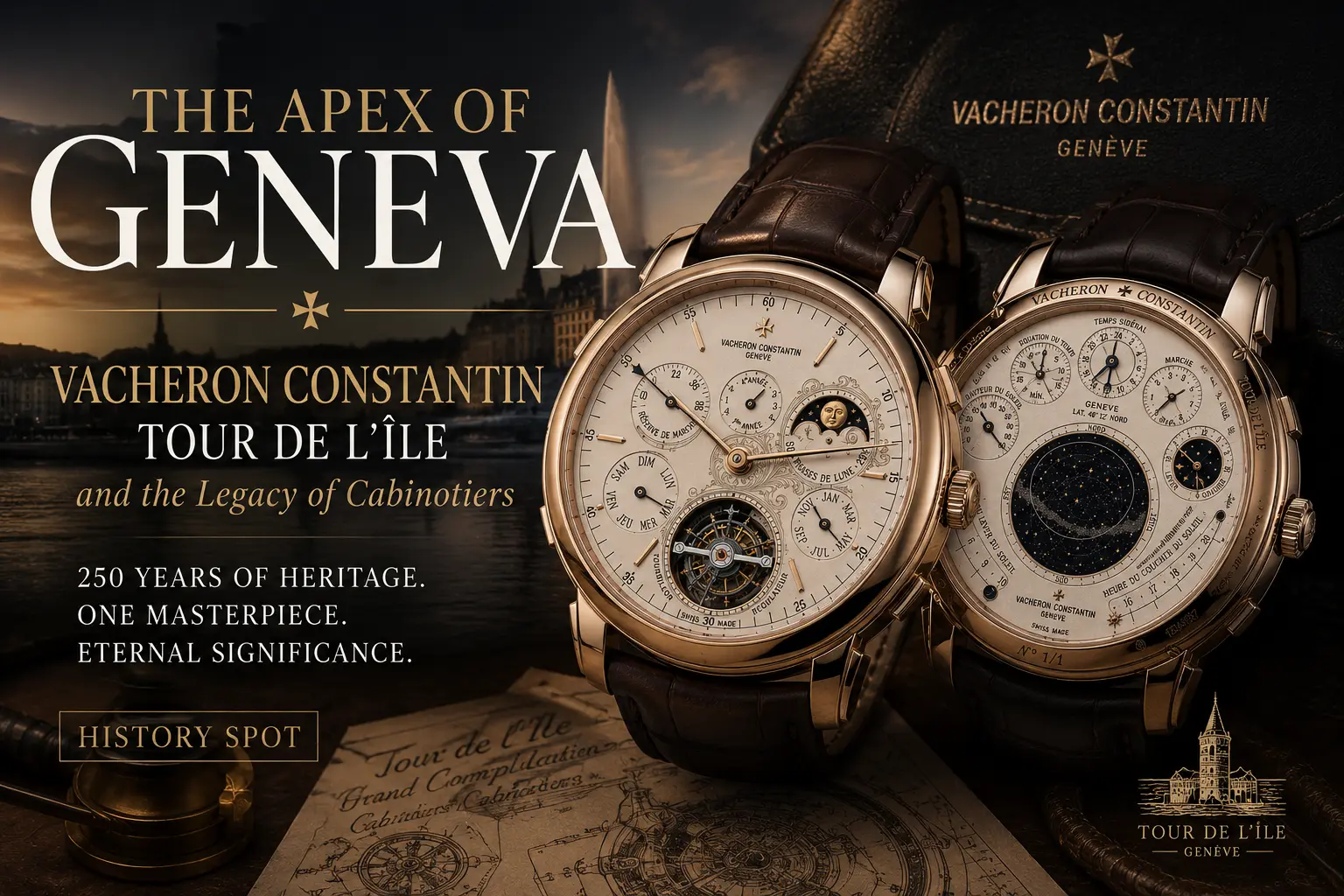
Geneva’s history is etched into the Tour de l’Île’s very name: the Tour de l’Île – “tower on the island” – is a medieval Rhône fortress where Vacheron Constantin later established its 19th-century workshop. For the ultra-wealthy connoisseur, few timepieces embody lineage and luxury as the Tour de l’Île. Unveiled in 2005 to commemorate Vacheron Constantin’s 250th anniversary, it is a supremely complex wristwatch that intertwines celestial science with Genevan artistry. Each aspect of its design – from the engraved case to the gilded hands – reflects a rich patrimony that began in 1755.
250 Years of Unbroken Lineage
The name Les Cabinotiers harks back to 18th-century Geneva master watchmakers who worked in sunlit attic “cabinets”. Vacheron Constantin’s roots run deep in this cabinotier tradition: since its founding in 1755, it has operated without interruption, making it the world’s oldest watch manufacture. Over 270 years the Maison has blended timeless craftsmanship with cutting-edge innovation, continuously raising the bar for haute horlogerie.
To honor this heritage, Vacheron launched the Tour de l’Île as the centerpiece of its quarter-millennium celebration. Only seven of these wristwatches were produced (with one prototype retained by the Musée Atelier Vacheron). The 47 mm by 17.8 mm pink-gold case encloses a movement that packs a staggering 834 components and 16 complications, making it “the most complicated two-sided wristwatch ever produced in a series” at the time. Each Tour de l’Île bears the prestigious Poinçon de Genève, a guarantee of Genevan finishing and precision. Its exclusivity and craftsmanship were quickly rewarded at auction – in April 2005 one example sold for CHF 1,876,250 (about USD 1.56M), then setting the record as “the most expensive serial, modern wristwatch ever sold”.
The Anatomy of the Double-Sided Masterpiece
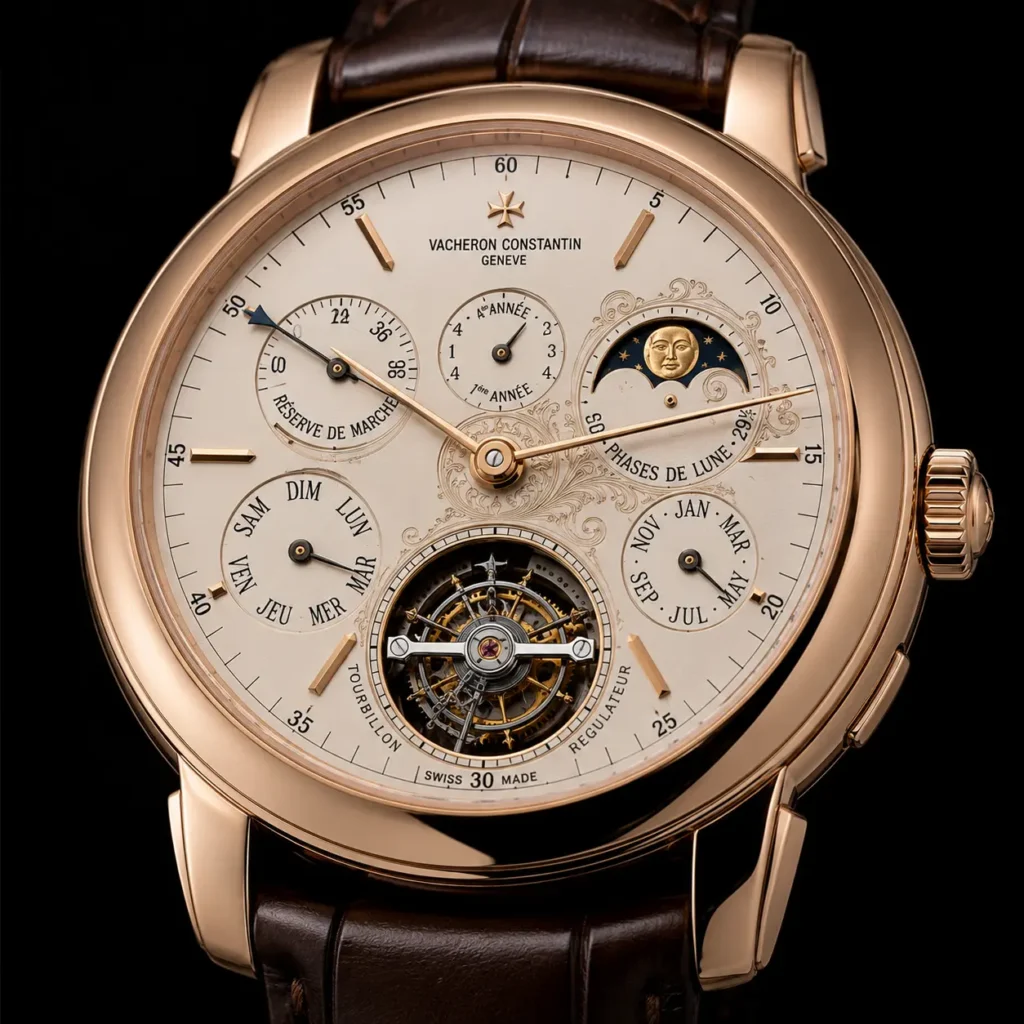
The Tour de l’Île’s genius lies in its double-faced complexity. A manually wound Caliber 2750 movement drives its array of displays. Encased in rose gold, the movement’s 834 parts (including the tourbillon carriage) choreograph 16 complications. On the front dial, a flying one-minute tourbillon sits at 6 o’clock, carrying blued-steel hands for the hours and minutes. Flanking the tourbillon are subdials for the power reserve and the moonphase – the latter with a meticulously hand-engraved gold moon – while a small hand tracks the winding state (torque) of the minute repeater.
Complication Highlights
Tourbillon & Timekeeping
A 60-second flying tourbillon at 6 o’clock drives the hours and minutes with ultimate precision. Its mechanism is visible through the dial, symbolizing the Maison’s mastery of escapement.
Repeater & Moonphase
A minute-repeater chimes hours and quarters on command. Its winding (or “strike”) torque is indicated by a dedicated hand, and the dial includes a beautifully engraved moonphase (solid gold moon) for lunar tracking.
Perpetual Calendar
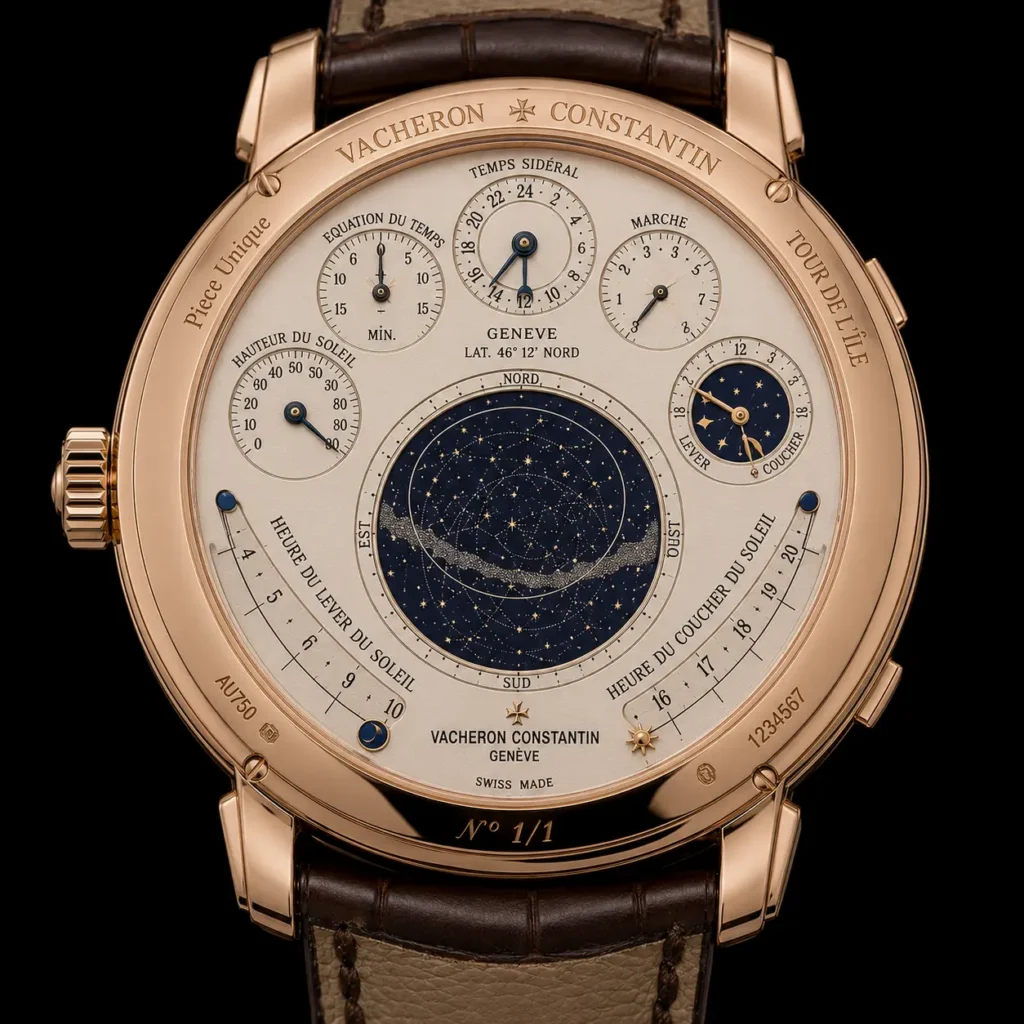
The reverse dial’s triple calendar automatically accounts for varying month lengths and leap years. Subdials detail the day, date, and month, with a discreet leap-year indicator to ensure perpetual accuracy.
Astronomical Functions
The Tour de l’Île translates astronomy into art. It features an equation-of-time indicator (difference between solar and mean time), a star chart mapping the constellations over Geneva, and dual sunrise/sunset displays calibrated for the city’s longitude and latitude.
For the ultra-wealthy collector, the Tour de l’Île is more than a watch – it’s wearable history. Each piece is a one-of-a-kind marvel where centuries-old Genevan artisanship meets modern innovation. The dial is executed in rich, multi-layered detail; the case is flawlessly finished; and every function reflects the Maison’s cabinotier spirit of mixing art with science. In the world of horological connoisseurship, the Tour de l’Île remains an apex creation: a microcosm of Geneva’s watchmaking golden age and Vacheron Constantin’s unbroken legacy.